A hearing test shows how well a person hears sounds at different pitches and volumes. It tells our audiologists whether there is a hearing loss, what type it is and how severe it is (mild, moderate or severe), so we can plan the right next step.
Some tests suit adults, others newborns and young children. Our audiologists choose the right tests after examining the patient. All are safe and painless.
What to expect at your appointment
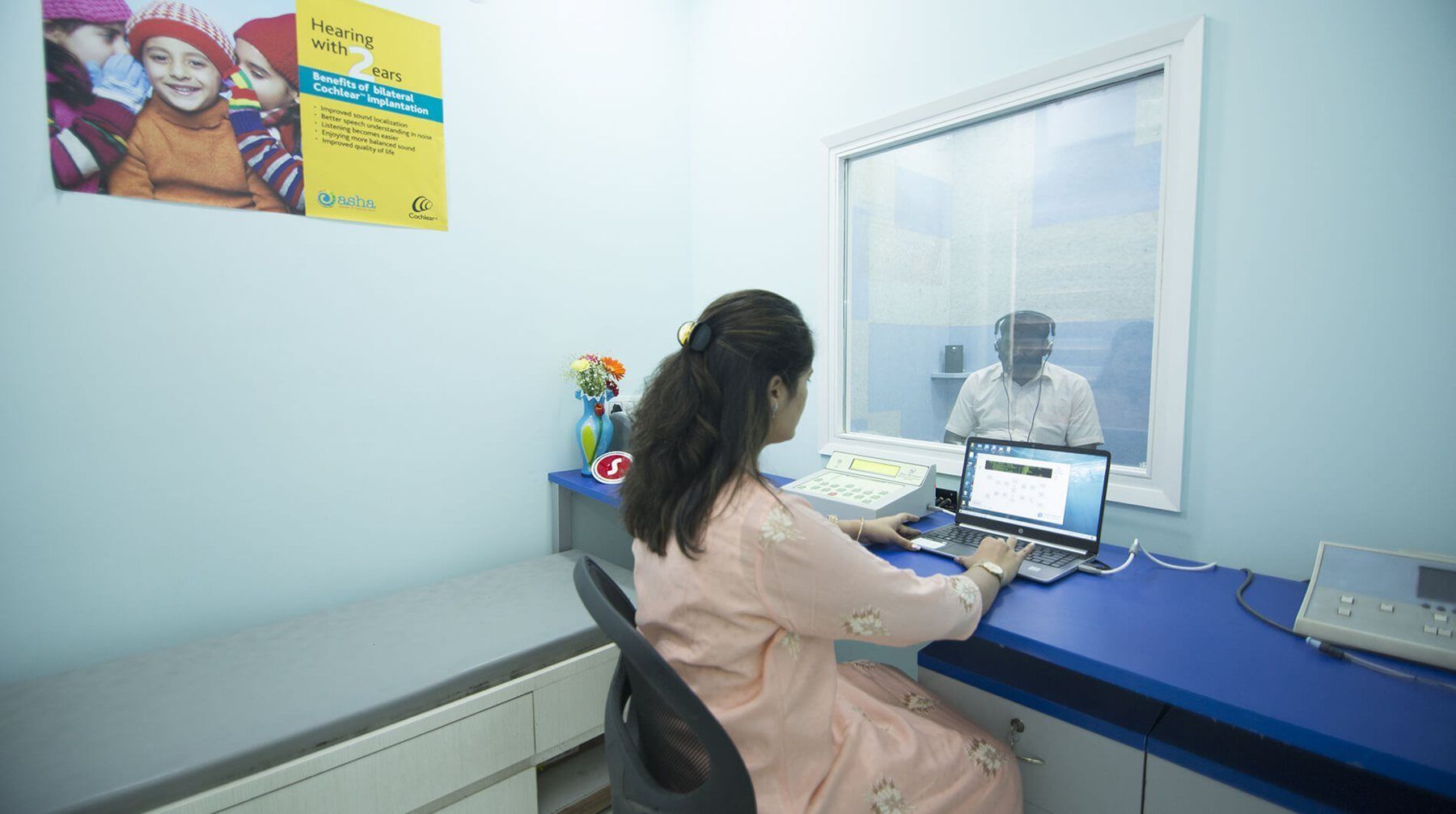
Tests take place in a sound-proof booth. Our audiologists explain each step, then go through your results with you and agree a plan: a trial of hearing aids, therapy, an assessment for cochlear implants, or a referral to an ENT doctor.
A few things help the results be accurate:
- Avoid loud noise for 24 hours before the test.
- If you have a cold or an ear infection, it is better to wait, as mucus in the ears can affect the results.
- If there is ear wax, the audiologist may need to clear it first, after speaking with the ENT specialist.
- Bring any earlier hearing reports you have.
Tests for adults and older children
Pure tone audiometry (PTA)
PTA is the main test for finding a person's hearing thresholds: the softest sounds they can hear. It shows the degree, type and pattern of a hearing loss, and whether it is conductive, sensorineural or mixed.
You wear earphones connected to an audiometer. The audiologist plays tones at different pitches and volumes to each ear, and you signal (by pressing a button or raising a hand) whenever you hear one. Your responses are plotted on a graph called an audiogram. Normal hearing on a PTA falls between 0 and 25 dB HL.
PTA suits adults and children old enough to cooperate.
Speech audiometry
You repeat words or sentences played at different volumes, in quiet and in noise. This shows how well you understand speech and helps decide whether a hearing aid will help.
Tympanometry and acoustic reflex testing
Using a small probe in the ear, tympanometry measures how the eardrum moves and checks the middle ear for fluid, infection or Eustachian tube problems. The acoustic reflex test measures a tiny muscle response to sound.
Tests for babies and young children
OAE (otoacoustic emissions)
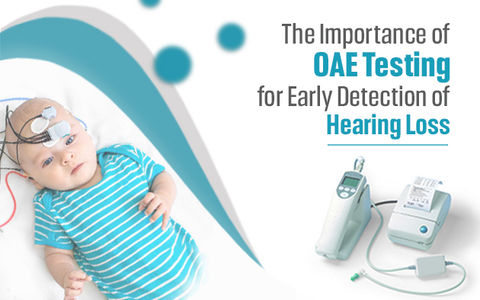
When the inner ear (cochlea) is working, it gives off a very faint sound in response to sound. An OAE test measures this using a soft-tipped probe placed in the ear canal while gentle clicks are played.
OAE is widely used for newborn hearing screening, ideally within the first month of life, with a follow-up test at around three months if needed. When the baby is quiet, the test takes only 20 to 30 seconds; it can take longer if the baby moves a lot.
BERA (brainstem evoked response audiometry)
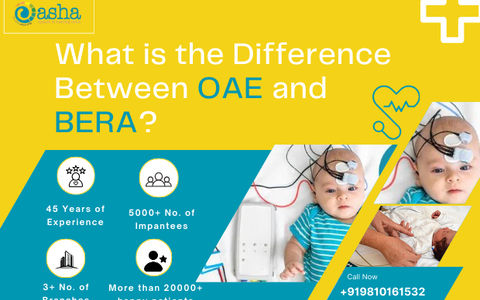
BERA, also called ABR, records how the hearing nerve and brainstem respond to sound. Small electrodes are placed on the head and behind the ears, and sounds are played through earphones. The patient does not need to respond, so BERA suits babies and anyone who cannot respond reliably.
The test is done while the child is asleep. Come with clean, oil-free hair so the electrodes stick well, and make sure the child has been fed; fasting is not needed. BERA shows the type, degree and location of a hearing problem and can point to nerve-related (retrocochlear) problems that may need further investigation. Results are always read alongside other tests such as OAE and ASSR.
ASSR (auditory steady-state response)
ASSR is also recorded with electrodes on the scalp, but it gives frequency-specific thresholds, usually at 500, 1000, 2000 and 4000 Hz, in both ears at the same time. This creates an estimated audiogram for children too young for behavioural testing.
ASSR helps us set hearing aids for small children and is key in deciding cochlear implant candidacy. Children should sleep during the test; adults can be tested awake.
Behavioural tests by age
- Behavioural observation audiometry (BOA): for infants under six months, watching for reactions such as startles, head turns and eye movements.
- Visual reinforcement audiometry (VRA): for children aged six months to two years, rewarding head turns towards sound with a visual toy.
- Conditioned play audiometry (CPA): for children aged two to five, who do a simple task, such as placing a block, each time they hear a sound.
Specialised tests
We also offer middle and late latency responses (MLR and LLR) for auditory processing concerns, and electrocochleography (ECochG) for inner ear conditions such as Ménière's disease.
Vertigo assessment
A vertigo assessment looks for the cause of dizziness or imbalance. After a detailed history, tests may include videonystagmography (VNG), which tracks eye movements, posturography, which measures sway, and positional manoeuvres such as the Dix–Hallpike test. VEMPs and caloric testing may also be used. The assessment takes about 60 to 90 minutes.
Avoid a heavy meal just before, and tell us about any medicines you take for dizziness, as they can affect the results.
We offer vestibular rehabilitation, a programme of exercises to improve balance and reduce dizziness. Most people benefit from 10 to 12 weekly sessions with daily home practice. For conditions that need medical or surgical care, we refer you to ENT or neurology specialists.